








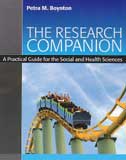
| Title: The Research Companion | |
| Author(s): Petra M Boynton | |
| Date of Publication: 2005 | Publisher:Taylor and Francis |
| Pages:viii + 199 | ISBN:1 84169 305 7 |
| Price: | Format:Softcover |
| Target Readership | Undergraduate | ||||
| Presentation/Style |  |
|
|
 |
|
| Content | |
|
|
|
|
| Literature | |
|
|
|
|
| Originality | |
|
|
|
|
| Overall | |
|
|
|
|
|
Content: 1 - Introduction; 2 - Planning Research; 3 - Starting out; 4 - Completing research; 5 - Participants; 6 - Researcher well-being; 7 - Once a study's underway; 8 - End results and reporting findings; 9 - Endnote. |
|
Review: Whilst there is a great deal written about research methodology there's far less written about the more practical side. Statistical analysis might be fine but you need the data in the first place. Standard ecological methods are well written about but increasingly we want to test public reaction or get human studies for a range of topics. This is where this text comes in. It aims to help the new researcher understand what is needed and how to go about doing research. Although the text's subtitle is 'a practical guide to the social and health sciences' there's much in it that can be of direct use to ecologists/environmentalists and indirect use to virtually all researchers. The introduction lays out the premises under which the book is written and highlights the main topics. It also has a number of tables highlighting the book's features and where to get more help on more theoretical topics. There's also a personal checklist to get the researcher to evaluate their own strengths and weaknesses. From here, the book takes the reader through the main elements of dealing with research from plan to publication. Thus chapter two starts this off with research planning. It's not just about the primary question - it's about questioning every aspect from personal motivation to correct design. To help, there's an extensive list of references given within the text so that any point can be expanded upon - a useful feature if you don't know what to do to start with. Chapter three looks at the logistics of starting research. Here, the assumption is that it's a team effort as most of the work suggests the need for space, planning and personnel skills. Rather than dive into the full-scale research, the careful researcher reads chapter four and follows the idea of test-driving the research through pilot projects. The chapter isn't just a warning - in keeping with the author's style, there are numerous links to other books, websites etc. Chapter five is a far larger one dealing with participants in the research. It's really a guide to getting the best information out of people in the best way and leaving everyone happy at the end. Chapter six carries on the theme of care and safety but directs it at the researcher because they too can become caught in some research flaws. The final two chapters are what one might see as the core (but we can now see as just the end process). Chapter seven looks at the quality of data and how to clean, sort and keep it so it can be used. Chapter eight examines the publication stage and how good quality work can be carried out. A final, brief chapter refers to the companion website which seems to have a good range of resources and a useful message board. Although this book lies slightly outside the ecology research sphere it does have a great deal of good information in it. It covers those aspects of working with people that many other texts ignore whilst still getting the core of the research task organised. The range of resources is impressive and the text has a lively feel to it. Those working in the applied science area would do well to read this text. |