









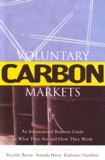
| Title: Voluntary Carbon Markets | |
| Author(s): Ricardo Bayon, Amanda Hawn and Katherine Hamilton (eds) | |
| Date of Publication: 2007 | Publisher: Earthscan |
| Pages:xix + 164 | ISBN: 978 1 84407 417 4 |
| Price: | Format:Hardcover |
| Target Readership | Educator | ||||
| Presentation/Style |  |
|
 |
|
|
| Content | |
|
|
|
|
| Literature | |
|
|
|
|
| Originality | |
|
|
|
|
| Overall | |
|
|
|
|
|
Content:
1 – The big picture; 2 - Understanding supply and
demand in the voluntary carbon market; 3 - How does the voluntary
carbon market relate to the US REC market?; 4 - The voluntary
carbon market: what experts think; 5 - A glance into the future
of the voluntary carbon market. Appendices. |
|
Review: Part of the problem with global warming is get get people to understand it exists and then to reach a consensus on what might be happening, when and the extent of change. The other part of the problem and one that is only just getting into public consciousness is the need to do something about it. The need for action is obvious but until recently tangible proof (or directions to go in) have been lacking. What we are seeing now is an attempt to get the burgeoning amount of work into the mainstream. One such area is carbon trading. Despite a rash of adverts and media copy in the last two years there have been projects going for almost a decade. One could argue that it's now time to let more people into the "secret" of dealing with global warming. The word 'dealing' here is deliberate. There is one strand of action that suggests since free-market thinking got us into this situation it ought to get us out. Whilst not entirely certain of the logic there are certainly enough cases where some (increasingly sizeable) money has been put where the corporate mouth is. In turn, there are organisations, such as the authors' Ecosystemmarketwatch site that have been monitoring progress. This book is one such product. For the uninitiated, chapter one is a crash course in voluntary carbon markets. These are largely smaller-scale systems run without the considerable legal tracking of Wall St, FTSE etc. but which seeks to offset the carbon produced by human activity. Once the scene has been set, chapter two moves in to an overview of how such markets work. Since these are still very new the processes are fluid but there's enough agreement on how to trade. Basically, the supply chain generates the pollution levels which are then verified. Carbon credits (offsets) are purchased to nullify the effect. So, if a company produces x tonnes of CO2 then it purchases forestry credits which would take up that carbon in the form of growing trees. These credits can be traded through a stock-market like any other commodity. What makes this market different is that it is undertaken for reasons other than profit - because it's voluntary people join in for philanthropic motives or as a desire for corporate social responsibility. Chapter three moves on to look at a more complex scene - comparing these early carbon markets with renewable energy certificates in the US. The idea is that by investing in 'green energy' you can also reduce carbon emissions. It's the consideration of this element that makes this market far more complex than straight-forward trading markets: not producing is the same as reducing if you want to lose something! Chapter four takes a step back. After the race through the scene, the authors/editors have asked others active in the scene to give their accounts of the carbon market's future. Naturally, as you would expect, they are upbeat but they are also cautious - there's no automatic right for these to succeed and there are many practical and theoretical issues that need to be solved. A very brief last chapter points to the future and what we might expect. This is followed but an unusually large set of appendices which detail a range of project types, actual examples, standards, credit sellers and institutional buyers. Many of these cases mention names, websites, amounts etc. so they should be easy to trace for more information. From a vague idea a few years ago this has become a serious player in the market. Current concerns over global warming should not dampen enthusiasm too much. Here is an example of a conventional market taking the idea of ecosystem services on board and proving practically (as many of us realised theoretically) that it is possible to be green and profitable. This book is a brief roller-coaster ride through the system. As such it needs some prior knowledge hence its designation for educators rather than students (who would find much to be excited about). Overall, a very good introduction to what promises to be a growth area. |