










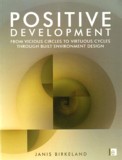
| Title:Positive Development | |
| Author(s): Janis Birkeland | |
| Date of Publication: 2008 | Publisher: Earthscan |
| Pages: xxii + 408 | ISBN: 978 1 84407 579 9 |
| Price: | Format:Paperback |
| Target Readership | Secondary | ||||
| Presentation/Style |  |
|
 |
|
|
| Content | |
|
|
|
|
| Literature | |
|
|
|
|
| Originality | |
|
|
|
|
| Overall | |
|
|
|
|
|
Content:
1 – A design for ecoservices; 2 - The case for
retro-ecofitting; 3 - Sustainable urban form; 4 - Development
standards and criteria; 5 - Building rating tools; 6 - Design
methods; 7 - Urban sustainability assessment; 8 - Regional sustainability
audits; 9 - Sustainability reporting; 10 - Future thinking tools;
11 - Ecoservice trading schemes; 12 - Bioregional planning; 13
- Constitution for eco-governance and management; 14 - Reversing
resource transfers; 15 - The SmartMode process. |
|
Review: Before anyone says 'not another sustainability book' (becuae it does seem have been the year for them) this is not the average. It focusses on improving the built environment so it could be seen as a kind of urban sustainability - the idea we should design buildings far better than we are currently doing (and we have the technology and we can save money/resources as well). A lot has hapened since the idea of Trombe Walls was floated in the 1960s. Today's buildings are (or really should be) far further along the road towards green buildings and that's the basis behind the book. Susbtitled 'from vicious circles to virtuous cycles through built environment design' the author highlights what is/can be done to improve our towns and cities. The core message - that we have the ability - is matched by the reminder that we have had this since the 1970s and that it still needs to become mainstream. The book is divided into 5 sections. An introduction sets out some of the basic ideas before we launch into the first section. It's message is one of 'positive development' i.e. not just minimising impacts but actually trying to improve conditions. This leaves the first section to expand on the case for such concepts. Starting with an overview of the need for such perspective, subsequent chapters look at areas such as retrofitting (it can be feasible) and re-thinking urban design. Having gathered the strong idea that we need a rethink, section two turns our attention towards building design. Three areas are explored - building standards, building assessment methods and urban design. In each case, the author notes current practice and then shows how it can be made more ecologically positive. A similar approach is used in the next section which turns its attention to environmental management in general and sustainability reporting in particular. Chapter 7 suggests that we should move from auditing which really just tries to reduce or control the impact to a more proactive idea of risk management where the focus is on trying to improve the area (socially, ecologically etc.). Chapter 8 takes a similar line in looking at regional audits. Exisitng ideas in this area include ecological footprint studies and material flow analysis. Greater interest is shown in techniques like life-cycle assessment which studies impacts over a greater area and timeframe and which seeks to minimise damage wherever possible. The final technique, sustainability reporting requires a shift from accounting for changes to being accountable for changes. The central idea is all this is the notion that we are able to do far more than currently we do (although 'why' is not the question asked here). Section four continues the critique to examine strategies and planning. As with the other sections it takes three cases, the first of which is 'futires tools' - the range of methods that allow some extrapolation into the future. The argument here is that by moving from the present towards the future we can fail to give weight to small trends that eventually pull us off course. It would be better to project into the future and work backwards. Chapter 11 tackles the various trading schemes e.g. carbon and shows their inherent weaknesses. The ideal here would be look at improving ecosystem services rather than paying for the poor use of some of them. A final chapter looks at the broader context of regional planning again suggesting that instead of trying to make it fit our purposes, we work withing its parameters. Having provided the critique of a range of design methodologies at a variety of scales, the final section puts together schemes that should improve conditions. If sustainability is to work it needs to be embedded in every facet of society. A key issue would be to create a governance system that promotes ecological ideas. The next move could be to question the basis of manufacturing and services and ask what we are trying to achieve and whether it could be better organised. Finally we are introduced to the SmartMode system. This is seen as a '12 step process'. A group (community, council, region etc.) could come together and work on this starting with ideas on sustainability, moving through design strategies and ending at measuring performance. As it goes through the various steps references are given back to the key chapters where the tools needed to create this Positive Development were critiqued. The remainder of the text (about 1/3 of the book) is given over to a large set of excellent 1-page summaries of some key ideas, examples etc. Basically, this provides extra ideas and expands on concepts that were only touched on in the text. A glossary, comprehensive chapter notes and index completes the book. This is a very interesting perspective. The book is crowded with detail and examples. The set of summaries covers some ground not easily found elsewhere. One interesting detail is that the entire five sections is written as a question and answer session. This is not a flow of ideas rather a punctuated series of questions leading the reader towards those points that the author considers to be appropriate to the answers being put forward. Those wishing to find a more linear flow might find this approach harder to understand but the beginner, who might not know which questions to ask, might find this a useful method. Either way, this is a useful introduction to the built environment debate where sustainability from the gound up has received too little attention. |