










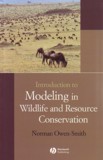
| Title: Introduction to Modeling in Wildlife and Resource Conservation | |
| Author(s): Norman Owen-Smith | |
| Date of Publication: 2008 | Publisher: Blackwell Publishing |
| Pages: x + 332 | ISBN: 978 1 4051 4439 1 |
| Price: | Format:Paperback |
| Target Readership | Educator | ||||
| Presentation/Style |  |
|
|
 |
|
| Content | |
|
|
|
|
| Literature | |
|
|
|
|
| Originality | |
|
|
|
|
| Overall | |
|
|
|
|
|
Content:
1 – Introduction - why learn modeling?; 2 - A starting
problem - conservation of the dodo; 3 - Descriptive models - choosing
an equation; 4 - Structured population models: age, size or stage;
5 - Consumer-resource models: population interactions; 6 - Simulation
models: assessing understanding; 7 - Harvesting models: adaptive
management; 8 - Population viability models: risk analysis; 9
- Metapopulation models: spreading the risk; 10 - Modeling infectious
diseases: outbreak dynamics; 11 - Scenario models: exploring options;
12 - Vegetation models: biomass to gap dynamics; 13 - State transition
models: habitat patch dynamics; 14 - Habitat suitability models:
adaptive behaviour; 15 - Reconciling models with data: statistical
diagnosis. |
|
Review: It is accepted that models are crucial to our understanding of complex environmental phenomena. Despite this, there are few general texts to help develop a sense of models and a critical awareness of how they work and the limitations they bring to our discussions. With global warming being reliant on models and the need for people to be better informed about model parameters it is important that this area be addressed. This year there have been a number of model and maths-based texts published which bodes well for understanding but the information still needs to get out to students. This text is aimed at post-graduate students and those following work in conservation. However, as with many books aimed at higher levels of study there is much we can learn and use in our work. Essentially, this is a computer modeling text using a version of Basic known as True Basic to produce a range of models which can be used to understand wildlife dynamics. Although it is possible to buy a copy, this book comes with a CD containing a limited version of True Basic and the programs mentioned in the text already coded (the system just needs installing). We start the book with a review of the modeling process and an overview of the text layout and contents. Chapter two poses a question of conservation management - how do you manage a dodo? Although obviously a fake question the discussion generated and the questions posed form a useful commentary on the idea of modeling. The aim is to construct a simple model to address key conservation requirements e.g. population numbers. Chapter three describes the range of equations that can be used to start modeling. From the basic dynamic equation to non-linear dynamics, the ideas of model complexity are outlined. Along with a set of examples on the CD, the reader is given the chance to explore some simple models to see what the effects of altering variables would be. From this point, the book describes a range of models each one covering a different aspect of wildlife conservation. The first one deals with population exploring age and stage structured examples. Chapter five increases complexity to look at predator-prey and similar situations. This leads on to simulation modeling where models are tested against data. This is a key step whose importance cannot be under-stated because if the model is not sound then all data will be liable to misinterpretation. One of the problems with wildlife is that often a species is being harvested at the same time people are trying to assess the viability of this. The earlier models such as maximum sustainable yield are being refined as shown in chapter 7 to improve data analysis - important for areas such as fisheries management. Chapter 8 takes this one stage further to examine risk analysis for population numbers. Next, we add the idea of having a number of populations. The aim is to reduce risk to wildlife but we need to see if this is in an effective option. Disease is a key issue in wildlife management but the dynamics of disease can also tell us about population spread and so chapter 10 discusses how we can model such behaviour. The next model deals with scenario building, an description of how we can test ideas without altering wild populations. The next three chapters all describe situations with vegetation either from the view of patches and gaps or through suitability of areas for animal management. A final chapter brings together the idea of testing models against data before using them further. There are several appendices which describe parts of the computer models. This is a very interesting text although one for the specialist. It does require some understanding of mathematics although much could be gained with only limited knowledge. The focus on method and theory as well as programming means that the text encourages the reader to question even basic assumptions (hopefully making a better model in the process). Each chapter has a range of cases and examples and the appendices (and CD) make this a very useful package. |