










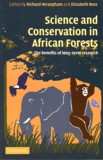
| Title: Science and Conservation in African Forests | |
| Author(s): Richard Wrangham and Elizabeth Ross (eds) | |
| Date of Publication: 2008 | Publisher: Cambridge University Press |
| Pages:xiii + 342 | ISBN: 978 1 521 72058 8 |
| Price: | Format:Paperback |
| Target Readership | |||||
| Presentation/Style |  |
|
 |
|
|
| Content | |
|
|
|
|
| Literature | |
|
|
|
|
| Originality | |
|
|
|
|
| Overall | |
|
|
|
|
|
Content:
1 – Why the link between long-term research and
conservation is a case worth making; 2 - Links between research
and protected area management; 3 - The use of research: how science
in Uganda's National Parks has been applied; 4 - Long-term research
and conservation in Kibale National Park; 5 - Monitoring forest-savannah
dynamics in Kibale National Park with satellite imagery; 6 - Long-term
studies reveal conservation for integrating habitat restoration
and animal nutrition; 7 - Long-term perspectives on forest conservation;
8 - Health and disease in the people, primates and domestic animals
of Kibale National Park; 9 - The importance of training national
and international scientists for conservation research; 10 - Community
benefits from long-term research programs; 11 - Potential interactions
of research with the development and management of ecotourism;
12 - The human landscape around Island Park; 13 - Conservation
and research in the Budongo Forest Reserve, Masindi District,
Western Uganda; 14 - Long-term research and conservation in Gombe
National Park, Tanzania; 15 - Long-term research and conservation
in the Mahale Mountains, Tanzania; 16 - The contribution of long-term
research by the Tai Chimpanzee Project to conservation; 17 - The
Green Corridor Project; 18 - Long-term research and conservation
of the Virunga mountain gorillas; 19 - Long-term research and
conservation of great apes; 20 - Long-term research and conservation:
the way forward. |
|
Review: There is always a danger that long-term projects will lose funding and/or staff. The chance to celebrate two events - the twentieth anniversary of the Kibale Chimpanzee Project and the tenth anniversary of the Kasiisi Project (both in Uganda) lead to a conference into long-term research and its benefits. Although highly specific to its subject the aim is to draw conclusions of wider applicability. The text comprises twenty papers each addressing a separate part of the issue. Although not formally divided into sections the text does have a logical flow to it. We start with an overview of the work. First is a reasoned argument as to validity of long-term research specifically in terms of conservation. The notion is put forward that we need such work but that it is increasingly difficult (and not just financial). 20 years of research is a long time and the logistical efforts increase especially in places with poorer infrastructure. Work then moves on to giving an overview of research, its use in conservation in general and Uganda in particular. The next set of three chapters looks at what lessons we can draw from the research as well as potential pitfalls. We start with a look at the value of satellite imagery to the work and continue with the value such work has in terms of conservation. The next set of chapters can be grouped around the idea of people and people management. There's work on human-primate disease transmission and its effect on conservation. There's work on training staff and the longer term benefits to the local community of supporting the project. This last point is crucial because it is made very clear that unless there is community support (especially in less developed areas) then there is little chance of long-term success. Our next move is to record the actual projects that have been conducted and the lessons that can be drawn for conservation in the boarder sense. Earlier chapters focussed on the primate work but these go outside the area with contributions from Uganda, Tanzania, Guinea etc. The last two chapters draw the broad conclusions and suggest ways forward. In this, chapter 19 considers the nearer focus of ape conservation whilst the last chapter discusses how long-term research, generally in conservation, can be developed. This is an interesting discussion about one neglected area of conservation (or ecology generally) - the need to look beyond the short-term and get some significant data, not just extrapolations. It's message is well put across but the subject focus suggests a specialised audience. Those with an interest in primate conservation and/or African conservation will find this an interesting read. |